• >>>NEW Colour 2.0 Workshop<<<
  • Technique
    • Latest Techniques
    • FREE TIPS
    • Quick Tips
    • Video
    • Site Search
    • Blog
    • Archives
  • Mentoring
  • 2026 Workshops
  • >Online Workshops<
  • Studio Lighting Books
  • Contact
    • Newsletter
    • Contact
    • Statement
Jake Hicks Photography
  • >>>NEW Colour 2.0 Workshop<<<
  • Technique
    • Latest Techniques
    • FREE TIPS
    • Quick Tips
    • Video
    • Site Search
    • Blog
    • Archives
  • Mentoring
  • 2026 Workshops
  • >Online Workshops<
  • Studio Lighting Books
  • Contact
    • Newsletter
    • Contact
    • Statement

Get Google to Tell You When Somebody Steals Your Photo

Welcome back to "This Week In Image Theft"! Once again the soulless parasites are out and about stealing my shots, and once again I have to waste my time trying to do something about it. But there are a few things that I can put in place to ease this pain.

Firstly there's the site Pixsy - they're a reverse image search company where you give them your images. You tell them where you keep your shots, then they look everywhere else online to see if they appear somewhere without your permission. It's an impressively powerful software and they manage to extract all kinds of results that I never thought possible. For a full review of the service you can check out my article here "Finding People Who've Stolen Your Photographs".

Pixsy is great at finding shots, but it can be a bit overwhelming when you receive your update email from them like this...

I think it's pretty safe to say that I won't be going through all of those 14,624 matches.

Granted a lot of those will be innocuous reposts of my blog and articles plus a bunch of sharing of my pictures etc., which is fine, but I'm also sure there will be a ton of illegal uses of my work in there too. The problem is that I'd have to spend a week or two - time that I don't have - to find them. If I was fortunate enough that somebody like Nike or Gucci had used a couple of my snaps then it would certainly be worth those two weeks but I highly doubt I'm that lucky. The most common offenders by far are nightclubs and the chances of getting any money out of them is frankly laughable.

It just doesn't make smart business sense to devote hours, if not days, of my time to sift through over 14 thousand matches of my work online. The stolen images above are the result of just going through the first 15 pages of 'image matches' on Pixs…

It just doesn't make smart business sense to devote hours, if not days, of my time to sift through over 14 thousand matches of my work online. The stolen images above are the result of just going through the first 15 pages of 'image matches' on Pixsy before I gave up.

So apart from the dragnet approach of stumbling around the internet looking for copyright infringes I can also get Mr Google to do some of the hard work for me.

Google has a feature called Google Alerts, which is basically a simple line of code that looks at the specific terms you've given it, let's say, "cute kittens & baby pictures". Google then collates a list of all webpages with that term and delivers them to you with a regularity that you dictate. So if you were to choose a more sensible "Alert" like your company name, for example, "Jake Hicks Photography" and you wanted to see every new page that used those words in combination, you could receive that data once every day. This is exactly what I do and the beauty of this is that you can literally set this up in under 2 minutes.

Go to https://www.google.co.uk/alerts for the page I'm referring to below.

Type your chosen alert in here...

Click "Show Options" to…. you guessed it.

new lerts.jpg
  1. Your desired alert phrase.
  2. How often you want to receive emails from Google about it. Once a day/week etc.
  3. News, video, blog etc. Choosing Automatic gives you everything in my experience.
  4. Your preferred language of trigger. For example if English is selected it won't show you results from France. With company names like your brand though always choose your language.
  5. The region specified to search in. For copyright infringement just choose "Any Region".
  6. You can choose between "Only the Best Results" and "All Results". I have no idea what modifier they use to determine "best" so simply stick to "All Results".

And you're done! It literally takes 2 minutes and it's super simple and surprisingly effective.

Once you've set up your Google Alerts, Google will send you an email at the end of the day with infuriating massages like this!

Once you've set up your Google Alerts, Google will send you an email at the end of the day with infuriating massages like this!

Google Alerts obviously doesn't look at your images, it works purely on text so it's going to give you different results to a reverse image search site like Pixsy will.

If all you wanted to know was the stuff about Google Alerts and setting it up then you're done. The rest of this article looks at a current copyright infringement case that I'm working on that was brought to my attention via Google Alerts, hence this article. If you're interested in the details then please continue.


So what is Google Alerts actually good for?

In my experience Google alerts generally just picks up re-blogs and a lot of Pinterest activity but every once in a while it does spot idiot companies who are stupid enough to actually include my name in their sales pitch alongside my pictures.

Pixsy hasn't caught this infringement yet, but Google Alerts did.

Pixsy has the facility to "submit a case" which involves you finding a copyright infringement yourself but passing it over to them to handle. Last week Google Alerts told me of this site that was selling cheap phone cases with my images on them so I took the information and submitted it to Pixsy.

Here's what they said...

So after submitting the online details an immediate and automated response says, "Pixsy Resolution is not available for this website, and more information is available in our FAQ. You are welcome to send a takedown notice instead.". Unfortunately I found nothing at all pertaining to this in the FAQ and as to why it's resolution centre won't touch it, but it's my assumption that Pixsy won't bother with this case because it's operating out of one of the copyright "dead-zones" like China. Upon looking under the contact details for the phone case company it does indeed appear to be doing exactly that.

As it stands at the moment the only legal recourse I have is to issue a takedown notice as per Pixsy's automated advice. I cannot find any reference to this action on their site and although I'm sure it's just me being daft I can't see how I can begin to implement such a thing. I sent them a message requesting help over a week ago and have heard nothing back as of yet. To be fair to them, there is no money to be made out of this on their end so the importance of my message to them isn't high. I get it - we're all businesses trying to make a buck, but I'd certainly appreciate any advice from either them or yourselves out there on exactly how I begin to implement a takedown notice.

Also, is it really worth it? Countries like China and other copyright lax countries steal stuff all the time to little or zero penalty. Should I bother wasting my time that I could be spending to make money in other ways just to satisfy my pride? Have any of you bothered to issue a takedown notice in a copyright haven and have you had any success or results?

I'd love to hear your feedback and experiences on this, guys, so please feel free to fire off in the comments section below, and I hope this article helps you find some image stealing scumbags of your own to stop.


Related articles:

A review on the reverse image search site Pixsy "Finding People Who've Stolen Your Photographs"

Adding copyright metadata to your shots via Lightroom "Adding Copyright Metadata"


:WARNING: Monies Required Ahead


I run regular workshops on some advanced lighting techniques like gelled and lighting and my post pro workflow. If you're interested in finding out more then please check out my "Training" page.

gel workshop trio.jpg

I also offer comprehensive coloured gel packs. These collections of gels are what I use day to day to create some of the most highly saturated colours around. If you're looking at getting into gelled lighting or need to get stronger and richer colours in your coloured gel work why not check out my Jake Hicks Photography Gel Packs

Tuesday 09.13.16
Posted by Jake Hicks
Comments: 2
 

Reading the Light - How shooting with gels can improve your white-light photography

Donate & SUPOORT

I've always wanted my photography education here to be free, so although there is no paywall to any of my -Technique Tuesdays-, any and all support is greatly appreciated. ❤️

PLUS: Donate any amount and I’ll send you a link to the hi-res print version of my studio lighting book.

||

PLUS: Donate any amount and I’ll send you a link to the hi-res print version of my studio lighting book. || PLUS: Donate any amount and I’ll send you a link to the hi-res print version of my studio lighting book. ||


Whether you like coloured gel photography or not, there's certainly a huge amount that can be learned from using them, and that knowledge can be applied to other areas of your photography to great effect.

When you start mixing multiple coloured gels together in an image all sorts of variables start appearing that simply aren't present when you shoot with white light alone.

When you start mixing multiple coloured gels together in an image, all sorts of variables start appearing that simply aren't present when you shoot with white light alone.

Gels, in my opinion, are one of the most unforgiving disciplines to master in lighting. They don't abide by the same rule book as white light and can often create puzzling results that leave you confused. Most of our entire photographic journey revolves around shooting with white light, so to suddenly change that can be a big stumbling block for many. For a start, gels have no "correct" exposure; they laugh in the very face of light meters as their resulting appearance is based purely on your preference rather than right and wrong; plus, colours can also get really crazy when they gang up. Mixing two or more gels together can create an almighty ruckus of confusing colour combos that, again, disregards the rule book on what we already know about colour mixing. For example, if you mix red, blue, and green gels together, you get white……..wait, what?!

People think, "oh, I gotta master white light photography before I play with gels". Not true - gelled lighting is an addition to creative lighting, sure, but you can also simply use gelled lighting to see what's wrong with the lighting in your images.

So, is jumping on the gelled lighting struggle-bus worth it? Sure, you get some pretty pictures, but it's not for everybody. What can you learn from gelled lighting that can be applied to your regular white lighting?

Reading the Light

I aim to briefly touch on "reading the light" in this article. I don't have a better term for it, but what I’m getting at is that I see so many badly lit white-lighting portraits out there, and the photographer clearly can't see the error with their lighting. When I say "bad lighting", I am not referring to simply my opinion of good and bad lighting; I'm referring to things like crossed shadows, underlit, dark eyes, no catchlights etc. Yes, these rules can be broken for artistic merit, but not when you're taking classic headshots or corporate portraits - that is the time for clean, flattering lighting, and not the aforementioned spaghetti junction of nose shadows and overexposed fill lights. If they’d taken these badly lit portraits with gels, the shocking reality of how funky their lighting was, would be all too apparent.

 
So here are three raw files of simple head shots. I've seen all three styles being used commercially and although there is nothing technically wrong with any of them, when they're put side-by-side like this it should be pretty easy to see which one …

So here are three raw files of simple headshots. I've seen all three styles being used commercially, and although there is nothing technically wrong with any of them when they're put side-by-side like this, it should be pretty easy to see which one looks a lot worse than the others. On the left we have a single key light, in the middle we have a key and fill light and on the right we have the same again but with too much power on the fill. If somebody had taken this right-hand shot at my studio, it's my opinion that they would need to be spoken to about some much-needed re-training as I feel this level of lighting is unacceptable in any situation.

Let's just take a classic, simple headshot: one key light above and a fill light below. Both lights are white, so it's almost impossible to see where the lighting from the key light falls on the face and where the light from the fill-light falls. Throw some gels on there, and suddenly, the reality of where each of those lights is falling is all too apparent.

Let's take another look at that same lighting scenario, but this time we'll take a shot with a coloured gel on the key light and a coloured gel on the fill light. It now becomes a LOT more apparent as to where each of those two lights are falling on…

Let's take another look at that same lighting scenario, but this time, we'll take a shot with a coloured gel on the key light and a coloured gel on the fill light. It now becomes a lot more apparent where each of those two lights is falling on our subject's face. We can clearly see that our orange fill light is catching some unflattering sections of the face that weren't readily apparent before we added the gels.

At this stage, I'm not even referring to exposure and how powerful your key light should be; I'm simply talking about where the light is falling. So, what exactly are we looking for? How do we know when the lighting is falling in the right place? First and foremost, you need to remember that I'm referring to lighting people and portraits - lighting is a synergy between light and pose. The best lighting in the world will look crap if the model is looking the wrong way, so you have to manage both correctly, but the one thing that all of this has in common is you, the photographer being able to "read the light".

Those who have followed my work for a while or have attended one of my workshops will know that I am constantly looking for "planes of light." When I say this, I mean having as large a section of colour and tone as possible while still having engaging lighting. What I am trying to avoid are lots of tiny broken sections of light and colour that are busy and visually confusing to the human eye, which in turn detracts from the overall image.

If you look at some of my work,&nbsp;even the most visually complicated lighting is still very clean. I always try to keep my colours clearly separated and as you see in the images above, all of the lighting in my shots is simply separated planes of…

If you look at some of my work, even the most visually complicated lighting is still very clean. I always try to keep my colours clearly separated, and as you can see in the images above, all of the lighting in my shots is separated planes of light.

Ok, so we've established that we're looking for large planes of light and not smaller broken sections of intersecting light and shadow. Now, let's put that knowledge into practice, review some of the raw files from one of my gelled lighting workshops, and see what I am looking for when I choose my favourite shots. Remember, I said that I am looking for large planes of colour, and I am desperately trying to avoid small overlapping sections of light.

You can give it a go yourself with the small group of images below. Can you choose the ‘best’ shots?

Here, we have a selection of raw files from my shoot. I'd like you to go through and mentally select the shots that show the best synergy between lighting and pose. Answers below. Click to enlarge

I gave you a small selection, and it should be relatively easy for you now that you know what you're looking for. But if you're still not sure, let’s take a look below to see which ones I kept and which ones I discarded.

In these images above you can see which ones I kept and which ones I didn't. Click to enlarge

Did you get them all right? To be fair, a lot of the selected ones I have already retouched and published, so you might have recognised some of them subconsciously anyway. If you didn't get them all correct, or you're just curious as to why I kept certain shots in and not others, then take a look below and see that I visually describe what I am looking for with those "planes of light".”

So here are my favourites, and above, I've outlined (literally) what I'm looking for with those "planes of light." You can see how my model clearly separates the lighting in these shots. She positioned herself to literally separate the key light and the fill light with parts of her body.

In these shots, I've outlined what just wasn't working lighting-wise on the model's body. This isn't the model's fault; she can't see how the light is falling on her, so it's going to be up to you first to know what you're looking for and then translate that to her. You should start to see what I mean now when I say "busy lighting". In these shots, the key and the fill light are mixing in awkward ways on the body, creating patches and pools of light that are visually distracting from the shots as a whole.

I hope that now you have a better understanding of the term "clean lighting" and some things to look for when you're trying to "read the light." Granted, this only touches the surface of what great lighting looks like, but I feel it is an important lesson to learn to see the light, and gelled lighting helps make that more obvious to the eye.

Bad lighting is something that is made all too apparent when using gels.

Another important point here is that it's not just about the lighting; remember, we said it's a crucial synergy between lighting and pose. All of the shots above are taken with the same setup, but it's just how the pose interacts with that light that can make or break a shot.

So, how does this apply to your regular white-lighting portraits? It's simply an exercise in seeing how the light falls on the model. Remember that this crazy-coloured lighting above is still just a classic key and fill clamshell lighting setup, but it goes a long way to show you what that light is doing, even if you can't see it with regular white light.

Like everybody else, I spent many years shooting with my favourite "go-to" white lighting setups. It wasn't until years later that I applied gels to those setups and saw for the first time what the light was actually doing. If you hate gelled lighting, then that is fine, but do not underestimate the power it has to improve your skills as a photographer with regular lighting.

If you get even remotely good with gelled lighting and then decide to never touch them again, I guarantee your white lighting skills will go through the roof. 

So, what do you guys think? Have you played with gels yourself and discovered things about your lighting that weren't apparent before? Are you tempted to throw some coloured gels on one of your classic white light setups and see what it looks like? If you do, then I'd love to hear about it. Reach out in the comments below.

Also, did you find this type of article useful? Do you find it interesting to see my thoughts on my image selection process? Did you find it helped when I outlined the areas of lighting separation? Would you like to see me break down other shoots in this way? Let me know in the comments below.

Finally, a big thank you to Amber Tutton, the main model in this article. All of these lighting example shots were taken at my recent Gelled Lighting Workshop with her, where I talked attendees through this "reading the light" process and how to communicate it to the model. If you're interested in coming along for the complete breakdown and to learn everything there is to know about gelled lighting, please check out my Gelled Lighting Workshop page.


Further reading on gels

An article on how to create perfectly lit gelled backgrounds in your shot Creating the Perfect Gelled Background

…and the follow up article to that, Keeping Perfectly Lit Gelled Backgrounds


JHP Livestreams…

I livestream every other Tuesday night via YouTube and there I answer your questions, critique your shots, take community images into Photoshop to work on them and discuss all manner of lighting tips and techniques. I look forward to seeing you and your work there real soon. Jake Hicks Photography - YouTube


All of my more advanced lighting classes are now available online!

||

All of my more advanced lighting classes are now available online! || All of my more advanced lighting classes are now available online! ||

LEARN MORE ABOUT MY ONLINE WORKSHOPS

If you liked some of the gelled lighting shots in this article and you'd be interested in learning how to take those shots yourself or you're simply interested in finding out everything there is to know about Gelled Lighting then why not check one of my workshops: Gelled Lighting Workshop


Tuesday 09.06.16
Posted by Jake Hicks
Comments: 10
 

The New the Old and the Vintage - Nikon's 'Worst' & 'Best' Zoom Lens Comparison

I'm going to preface this by saying that this isn't a lens review article, there are many photographers better suited for this topic, so if you're after refraction index comparisons and chromatic aberration charts this article probably isn't for you. This article is however my personal thoughts on three Nikon zoom lenses and their resulting images but also a broader look at how we as photographers covet lenses and other photographic gear. Is the latest and greatest piece of kit actually worth the investment?

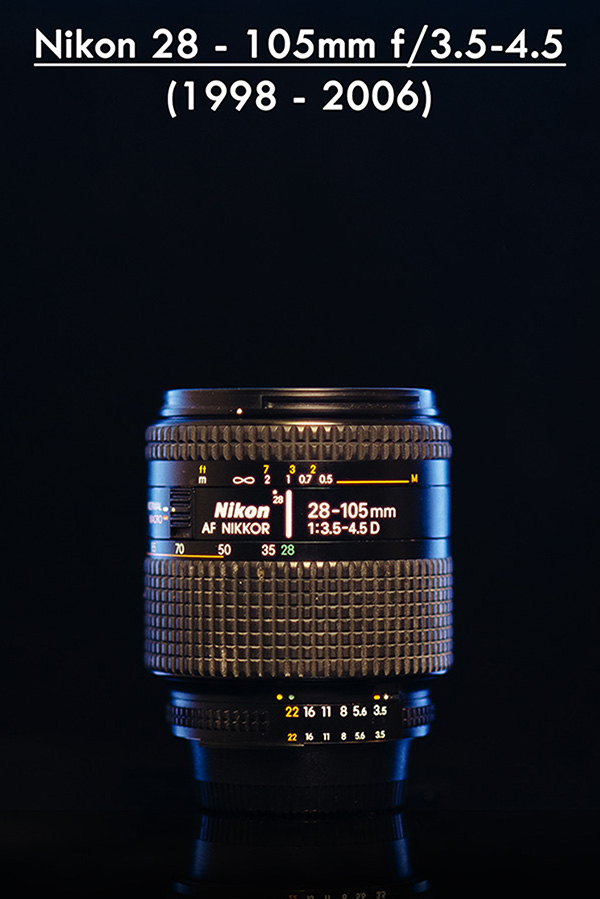
Some of my favourite shots that I've ever taken were captured using my Nikon 28-105mm f3.5 zoom lens. I've had this lens for more than a decade now and you can pick up a second hand one now for as little as £150.

Some of my favourite shots that I've ever taken were captured using my Nikon 28-105mm f3.5 zoom lens. I've had this lens for more than a decade now and you can pick up a second hand one now for as little as £150.

Let me set this up and step back a couple of months and say that I've been fortunate enough to see a lot of growth in my career recently but maybe not in the traditional sense. No I haven't picked up any major campaigns from Nike or Prada but I have seen a large growth in other areas namely socially and from a larger more global audience. I've done a lot of interviews in that time and I've even spent a couple of weeks in the US shooting an extensive training video regarding my lighting, equipment and photographic techniques. The point I'm trying to make here isn't about me blowing my own trumpet but about a common theme that started to run through these interactions with other industry professionals.

During these interviews and Q & A sessions the question about gear inevitably comes up.

'What gear do you use to create your images?'

It's a valid question and one that we're all interested with in todays market because no matter the techniques we use we still need tools to implement them. After the question is asked I would always simply reel off the key pieces I use which everybody cares about; lighting, camera body and lenses. My answer is of course always the same as I've been using the same kit for many, many years; Bowens lighting, Nikon D600 body and a 28-105mm f3.5 lens. What was interesting to me was that the response to my answers was always the same too.

'Wow, that's awesome, you take your stunning images using that equipment?'

At first I didn't really think anything of it but after a while it started to nag at me. Essentially the response they're giving is 'Wow, that's awesome, you take your stunning images with that old, outdated equipment?'. They are absolutely correct of course, yes I do. I have six Bowens strobes that I've had nearly 15 years now, my Nikon D600 came out in 2012 and can be picked up for around $400 and my workhorse lens was over a decade old.

I am not what the industry refers to as an 'early adopter'.

The thing is that my kit just works, it does what it's supposed to do and it creates the images that I want, but I did start to feel a little guilty, almost like a fraud. I'm a professional photographer, I make my living from photography, surely I should have the best possible photographic equipment to take the best possible photographs right?

I've been carting about the same Bowens strobes for nearly 15 years. I think to say that 'I've had value for money out of these heads' would be an understatement.

I've been carting about the same Bowens strobes for nearly 15 years. I think to say that 'I've had value for money out of these heads' would be an understatement.

So the nagging in the back of my mind finally got the better of me and I decided to 'invest' some money back into my craft. The question was where to start, my lighting, camera or my lenses?

Lighting

My strobes produce light, and unless I missed an issue of New Scientist recently light is still travelling at the same speed and still in a straight line, I didn't feel that new lighting was going to make a huge difference to my shots. Does modern lighting offer more control and more convenience? Yes it absolutely does but it still produces light so I didn't feel a new investment there would net me career changing results.


Camera Body

As of August 2016 Nikon has released 7 new full-frame DSLR cameras in the four years since my D600 was released in 2012 and this doesn't even include the 8 cropped sensor bodies they've also brought to market in that time. Has camera technology moved on? Sure, but is it an evolution or a revolution we're seeing?

Prior to my D600 I had a Fuji S2, it was Fuji technology in a Nikon body that took Nikon lenses. That camera did serious work and offered insane results for a cropped frame 6 megapixel camera. I stuck with the Nikon lens mount and waited ever so patiently for Nikon to introduce that D600 full-frame DSLR. Canon had their full frame powerhouse 5D Mk II in 2008 but I held my ground with the other nervous (and very patient) Nikon shooters and waited for the D600. It was well worth the wait in my opinion and I absolutely love my D600 but I personally don't think there has been a newer model that's been released that would change my game considerably.

I use my camera on manual mode 100% of the time and I've seen about two menu screens the whole time I've owned it. I don't personally need all the picture modes and effects, it shoots raw and in full frame, beyond that the new camera models offer me luxuries but not necessities.

In late 2011 I shot this album cover for musician Dan Le Sac. The shot was taken on my 6 megapixel Fuji S2 camera with my old Nikon 28-105mm lens.&nbsp;I shot the image as he and his record label had requested but it later transpired that they would…

In late 2011 I shot this album cover for musician Dan Le Sac. The shot was taken on my 6 megapixel Fuji S2 camera with my old Nikon 28-105mm lens. I shot the image as he and his record label had requested but it later transpired that they would go on to release the image heavily cropped like you see here (oddly no subsequent retouched or enlarged file was requested). The full un-cropped version has never been shown and the cropped image was used for everything from album art to Adshel's. With those bus shelter Adshel's being nearly 2 metre by 1.5 metre that is a terrifying crop to use from a 6 megapixel camera and old lens and I was literally stunned as to how well the image stood up to this type of enlargement.

Lenses

So finally we come to lenses. Lenses are often seen as the soundest investment you'll ever make in photography. Your 'glass' will very often outlive all other equipment you own and they will often see you through multiple camera body purchases. For example the current Nikon F-mount lenses have been around since 1959! I don't want to sound like a Nikon fan-boy here but that is insane. To think that something that was designed and engineered at a time when we barely had a vaccine for polio, no man had been to space and at a time before computers even had a name, Nikon made a lens mount that is still being used to this very day on their most modern cameras. So yes, buying a Nikon lens is a fairly solid investment and I am pretty sure it's a safe bet that any Nikon lens bought now will see you through many years to come.

So thanks to a little judgment from my industry cohorts and unintended peer pressure that left me feeling guilty I begrudgingly decided to finally buy a new lens.

For my type of work that primarily involves photographing people I wanted a fast zoom lens. My previous lens was half way there at least but really in terms of upgrading there is only one clear choice and that was the 24-70mm f2.8. You can't really find a more highly decorated lens and everywhere you turn there are people raving about how good this lens is so I bought one. You can pick one up here in the UK for around £1200 or in the US for about $1800. Like I mentioned lenses stick around for a very long time so I picked up an exceptional quality second hand one for £850. Of course it's nice to buy new but it's a working lens not an ornament so I was more than happy to get a pre-loved one and with modern returns policies there's practically zero risk if you aren't happy.

Are we nearly there yet?

Once again thanks to all of you who made it this far in one of my articles but we can finally take a look at what I thought of the lens. I've only had it a couple of weeks and although I've shot several shoots on it already I actually haven't gotten around to retouching any beyond these specifically shot test images.

So are you happy with the new lens?

Yes I am happy, it produces great shots just like I felt my previous lens did. I loved that lens and I still have it.

Will you use your old 28-105 lens again now that you have this new one?

No, theres no reason to but I doubt I'll ever get rid of it. It's simply not worth anything, you can pick it up for £150 now so its worth far more to me as a backup.

I only did this shoot a few days ago so it hasn't made it into the editing queue yet but here's a back of the camera shot of the club we were in. It had a couple of really low wattage goldfish bowl style bulbs which I wanted to include in the shot b…

I only did this shoot a few days ago so it hasn't made it into the editing queue yet but here's a back of the camera shot of the club we were in. It had a couple of really low wattage goldfish bowl style bulbs which I wanted to include in the shot but to get any light to show I had to shoot at ISO 800 1/60 sec. at f2.8. This shot simply wasn't possible with my older slower lens.

Were you blown away with the quality of this new and highly recommend 'must-have' lens?

No, not really. Don't get me wrong there's nothing wrong with the lens but for some reason I was expecting to be blown away. But that's more to do with the fact that everybody was hinting at the fact that my old lens was crap. It simply wasn't. It's true that about 80-90% of the shots on my site were taken with a lens that you can buy for £150 now but it was a remarkable lens. It had its limitations of course, namely its speed. I could only shoot at a max aperture of around f4 most of the time. Just days ago though I was shooting in possibly the darkest London club I have ever been into. I was shooting a mix of ambient and flash but my settings were ISO 800 1/60.sec f2.8. That is dark! The images I took last week simply would not have been possible a couple of weeks prior, I couldn't go slower on the shutter speed and I really didn't want to go noisier than ISO 800 so for that shoot alone the lens was worth it.

It got me thinking though, how good are these old Nikon lenses? My old lens was first introduced in 1998 and it's a really good lens, how long ago did Nikon nail it in terms of creating great glass? I decided to look into how bad Nikon lenses actually were before they got good. Upon my search I came across our industry legend Ken Rockwell and his list of 'Nikon's 10 Worst Lenses' (it's actually only 6 as he couldn't find 10 crap Nikon lenses). At the top of this list is the Nikon 43-86mm f/3.5 which Ken affectionately coins as 'the worst lens Nikon has ever made'.


In fairness to Nikon this 43-86mm zoom lens was first introduced in 1963. They soon realised their errors and re-released a far superior version in 1975. How can you tell the difference between the two versions? I now have both and the only cosmetic difference is the older version has its lettering inside the filter ring and the later version has it on the outside.

In the image here the lens on the left is the improved version and the lens on the right is the original.


Challenge accepted Ken!

I had to see what the worst Nikon lens ever made is all about so I grabbed one. As you may well imagine, you can buy Nikon's worst lens for a generously low price and I 'invested' in mine for the princely sum of 20 pounds. Score!

Ken Rockwell is no slouch when it comes to lens reviews and the guy knows what he's talking about so I was interested to see how bad Nikon had screwed up here. Thankfully my 43-86mm f3.5 (seriously Nikon what the hell zoom range is that?) lens arrived in time for me to test it alongside my new 'Godly' zoom lens as well.

So begins the New vs. Old vs. Vintage lens comparison test. This is far from scientific, just practical results taken as I would normally shoot and all retouched in the same way I would normally retouch.

Each lens had five 3/4 length shots taken at f5.6 at 50mm and five head-shots taken at f5.6 at 70mm. I chose the 'best' (sharpest) frame from each of the five shots and retouched them all in my normal process with each image receiving the same amount of time. Bear in mind that the vintage 43-86mm is manual focus and seeing as it doesn't talk to the camera directly, user focusing error is also a factor.

Clicking on the images above will enlarge them - The two images above were taken on the Nikon 43 - 86mm f3.5. The 3/4 length shot was taken at 50mm and the head-shot was taken at 70mm and both were shot at f5.6.


Clicking on the images above will enlarge them - The two images above were taken on the Nikon 28 - 105mm f3.5-4.5. The 3/4 length shot was taken at 50mm and the head-shot was taken at 70mm and both were shot at f5.6.


Clicking on the images above will enlarge them - The two images above were taken on the Nikon 24 - 70mm f2.8. The 3/4 length shot was taken at 50mm and the head-shot was taken at 70mm and both were shot at f5.6.


Below are some cropped-in versions of each of the files above so you can get a clearer picture of what's going on with each of the lenses. Clicking on the images will enlarge them.

View fullsize Vintage - 43-86mm 3/4 Crop
Vintage - 43-86mm 3/4 Crop
View fullsize Vintage - 43-86mm Head Shot Crop
Vintage - 43-86mm Head Shot Crop
View fullsize Old - 28-105mm 3/4 Crop
Old - 28-105mm 3/4 Crop
View fullsize Old - 28-105mm Head Shot Crop
Old - 28-105mm Head Shot Crop
View fullsize New - 24-70mm 3/4 Crop
New - 24-70mm 3/4 Crop
View fullsize New - 24-70mm Head Shot Crop
New - 24-70mm Head Shot Crop

Thoughts...

The Vintage - First off it's no shocker to see that the 50 year old lens is not up to the same standards as the modern lenses, we hardly needed to read a review to find that out. In the 3/4 length shot you can clearly see how soft it is at the edges and up around the face is loses a lot of definition and sharpness. It would also appear that it struggles with highlights greatly and the detail gets lost almost instantly as the brightness gets anywhere near a highlight. You can see in the headshot that the cheek bone highlight gets blurry due to flaring in the lens.

The Old - This lens has been a workhorse for me and I've never had cause for complaint. In the 3/4 length shot again you can start to see a slight blurring at the top of the head at the extremities of this lenses focal plane. Once again I would also say that the headshot sees a very small amount of flaring from the highlights and the pores loose a little definition in the cheek bones highlights because of it. Am I picking holes in this lens? Yes. Do I consider these to be usable and saleable commercial images? Yes.

The New - As you'd expect, the images taken with this lens are great. At first glance the 3/4 length shot may appear to be less than tack sharp to you and I'd agree with you. Personally I don't think this is a fault in the lens, I think this is a byproduct of 'focus and recompose'. You focus on the head and then make minor adjustments in the composition which renders the desired area slightly out of focus. I wrote an article on the effect here to better explain whats going on: 'Stay Focused'. But apart from user error you can see that the image as a whole looks clean and clear from edge to edge. On the headshot we see the same thing and for me the most noticeable differences here are the detail in the highlights. The cheek bone highlights retain all of the pore detail and the shadow areas in those pores are not loosing darkness due to flaring from the surrounding highlights.

More History (sorry)

So what does all this mean to me and why did I bother writing an article on something we as photographers should instinctively know by now? It's obvious that newer lenses create better photographs. It is obvious but I think we may sometimes loose a little perspective on this 'better' scale.

Take the vintage 43-86mm lens, remember this is reputed to be the 'worst' Nikon lens ever, this lens is older than most of its owners and to put it into perspective, one year before this lens came to market audio tapes were invented. That is crazy, you'd expect a lens that is dubbed as the worst lens ever and made at a time before pocket calculators that it would be like shooting through an old sock! It just isn't. Yes it's soft, yes it's blurry at the edges, yes it flares at the highlights but it's still usable and frankly a shot taken with this lens and displayed in the most common format of our generation i.e. our phones, nobody would ever know.

Ok so lets fast forward nearly half a century and compare what Nikon is up to now. The older 28-105mm lens that I've been using for over ten years and taken literally tens of thousands of frames without incident, repair or service, how did those images compare? Pretty damn good in my opinion, yes its an 'old' lens but I have shot commercial jobs on it for my entire career. It's images are in books, magazines, Adshels, posters and nearly every other printed media out there and I've never once thought 'oh that's a bit soft/flat/distorted'. That lens is an absolute workhorse and neither you or anybody else could expect any piece of engineering to withstand those years of day-to-day use and abuse with very little tender loving care with zero maintenance or repair.

Move forward a few more years and we've got Nikon's latest and greatest zoom lens (almost latest, a newer VR version has now been released). As you'd expect this lens takes fantastic shots but is it a quantum leap forward from the older 28-105mm I had? No I don't think it is. It's simply just physics at this point, in fact camera sensor technology is getting so damn good now that we're literally starting to see the physical glass of the lens in our shots. Making something physically solid yet completely transparent was black-magic a few hundred years ago but glass has been around since 3500 BC, we have been refining it for a while now and we're getting pretty damn good at it. But a lens isn't all about sharpness. This lens is very fast through the range and having that f2.8 has already helped me out on a shoot after only having it for a week. It's also a lot quieter to focus than the old one and it focuses a lot faster and in lower lighting, there's no mistaking this a far superior lens.

In Conclusion (you made it)

Lens technology has in my opinion crawled along. We've been working with glass for over 4500 years so its understandable that we already had a handle on it 50 years ago. The apparent slow growth of lens improvements is nobodies fault, you can't blame them for 'nailing it' right out of the gate. Smarter electronics and software companies nail it straight away all the time but slowly drip feed those improvements and updates to eek out the consumer budgets. It's just business. All I'm saying is that even the WORST NIKON LENS is still actually pretty damn good.

Don't fall foul to thinking you always need the latest and the greatest lighting, camera body or lens. What would give you better shots, spending £1000 on a slightly updated lens or spending £1000 on 3 or 4 awesome location shoots with professional models, stylists and makeup artists?
I think you know the answer.
 

Why not let me know your thoughts. Have you bought a lens that you felt revolutionised your images and portfolio? If so I'd love to know which lens it was. Or have you been holding off buying a new lens and think your money would be better spent on a few awesome photoshoots? Fire away in the comments below and as always if you have any questions I'll do my best to answer them.


Another article that is relevant to this lens discussion is the one I wrote on focusing and correctly choosing focusing modes. A lot of the time soft focus shots are the product of user error, not engineering. Stay Focused

I often get asked what is the best focal length for portraits. In this article I look at the key differences between 50mm vs 85mm: Which is best for Portraiture?

Also here's a look at some of the art lens reviews I've done in the past. These lenses are all about creative looks over technical refinement and they each offer something unique.

Lensbaby Velvet 56mm f/1.6

Petzval 58mm Bokeh Control Lens

Lensbaby Twist 60mm


:WARNING: Temptation lies ahead


If you liked some of the gelled lighting shots in this article and you'd be interested in learning how to take those shots yourself or you're simply interested in finding out everything there is to know about Gelled Lighting then why not check one of my workshops: Gelled Lighting Workshop


I also offer comprehensive coloured gel packs. These collections of gels are what I use day to day to create some of the most highly saturated colours around. If you're looking at getting into gelled lighting or need to get stronger and richer colours in your coloured gel work why not check out my Jake Hicks Photography Gel Packs

Tuesday 08.23.16
Posted by Jake Hicks
Comments: 3
 

T.W.i.P Talks Video Interview - Using Coloured Gels with Jake Hicks

After being a massive fan of This Week in Photo for many years I was incredibly honoured to be asked by the legend himself, Fredrick Van Johnson, for a video interview.

If you're not aware, Fredrick is the mastermind at the helm of This Week in Photo, one of the top photography podcasts out there and his weekly show has been in my podcast queue for many, many years.
In the video we discuss my early beginnings, my path to coloured gels and how I organise my model shoots as well as some all important lighting tips with gels.


I hope you guys like it and like I said I'm a huge fan of TWiP and have been an avid listener for many years so to be interviewed by Fredrick was a real treat for me indeed

In this episode of TWiP Talks I speak with Jake Hicks, not only does Jake have amazing style and talent, but he's a master of the art of using colored gels. In this interview you'll be "exposed" to how Jake manipulates his background, shadows and highlights in both exposure and color.
Tuesday 08.16.16
Posted by Jake Hicks
 

Set a Light 3D Software Review and Showcase

Something a little different this week in the form of a video. I've been asked multiple times about the lighting diagram software I use to create my Tech Tues articles so I thought I'd do a little review on the software and it's features.
Set.a.light 3D is the extremely powerful lighting setup software that allows users to build complex 3D lighting diagrams in mere minutes. I was going to write a review but realised there was way to much to cover so I decided to go through and actually record myself as I build a gelled lighting setup that I use to showcase some of its powerful features.
It does come in at 25 minutes which I know is beyond the scope of most internet users but grab a coffee and see what this awesome software has to offer :)
Thanks for watching!

If you're looking to purchase a copy of this software, then head on over to their home on the web https://www.elixxier.com/en/products/... and if you decide to purchase then make sure to use the promo code at checkout for a 15% saving JAKE-ROCKS2016.

Disclaimer - I don't get any kick-backs on that purchase code.  I reached out to the developers and said I was going to write this review, they'd seen my work, they love what I do and so offered up this code to you guys. The review is completely unbiased in terms of any monetary compensation.

Tuesday 08.02.16
Posted by Jake Hicks
Comments: 2
 
Newer / Older